Research
Investigate the conditions behind reliable work
AI research here examines how identity policy and evidence shape industrial and organizational decisions.
The work connects cloud-native infrastructure, zero trust, edge security, and industrial AI with the practical choices that keep operations accountable.
Research Lines
Questions guiding the research
Each line begins with a hard operating question and follows it through technical design, governance and behaviour that can be observed.
Edge nodes sit furthest from the cloud and are the easiest to lose unnoticed. This line has every node keep proving its trustworthiness with hardware-rooted evidence, and hold its boundary on site even when the cloud is out of reach.
Cloud-native systems
A system declares the state it should be in and keeps converging towards it; parts can be replaced and every change can be traced back. This line carries those properties from the data centre to the factory floor and onto a company’s own servers.
Digital enterprise governance
Access control, separation of duties, risk review and operating rules brought into one governance framework, following how zero-trust principles reach from a single system into decisions across an organisation.
Governing AI agents
Once AI acts in a system on people’s behalf, permission can no longer be a box on a settings page. This line lets each capability an AI holds be granted one at a time, never widened by the AI itself, and recorded with every call.
Grounded industrial AI
An industrial floor has no room for confident mistakes. This line makes the factory’s own knowledge the authority an AI answers from, has every number calculated from the data, and has the AI name what it does not know rather than guess.
Document AI on a machine you own
Much of what a company knows lives in scans, slides and spreadsheets, and reading them well takes several vision-language models at once. This line fits those models, and the caches they grow, into the fixed memory of one machine the company owns, and measures what each way of dividing that memory costs in speed, answer quality and stability.
Machine memory that can be measured
An AI’s understanding of each machine should build up over time, without its reliability becoming a matter of faith. This line keeps the source and the outcome of every conclusion, so that what the AI has learned can be measured rather than merely trusted.
Industrial data annotation
Industrial models are only as good as their data. This line studies how language and vision models can take on the manual annotation of industrial datasets while holding the quality of what results.
From energy data to decisions
Energy data is mostly recorded and seldom used. This line studies how meter and equipment readings become judgements someone can act on, and how the same record can carry the evidence an energy audit asks for.
Rules as versioned data
Rates and brackets change from year to year, while past figures must stay exactly as they were. This line treats rules as data with effective periods, so every result computed from a rule remembers the version it relied on.
Method
Test ideas where decisions carry weight
Questions move between architecture, security controls, organizational roles, and operating records. Experiments and evaluations make the assumptions visible, while field conditions show whether a conclusion remains useful beyond a controlled setting.

The strongest findings can guide both a technical boundary and the decision process around it.
Publications
Read the work behind the practice
Laysi pursues AI research along many lines, tests it under real conditions and publishes what holds up.

Future Generation Computer Systems
Zero-trust node security for KubeEdge: A policy-as-service architecture and reliability evaluation
A compromised edge node can go on appearing healthy. The work has each node continually prove its trustworthiness with hardware-rooted evidence, and isolate itself on site when verification fails or the cloud falls out of reach. Its reliability is evaluated across 900 automated runs.
Preprint
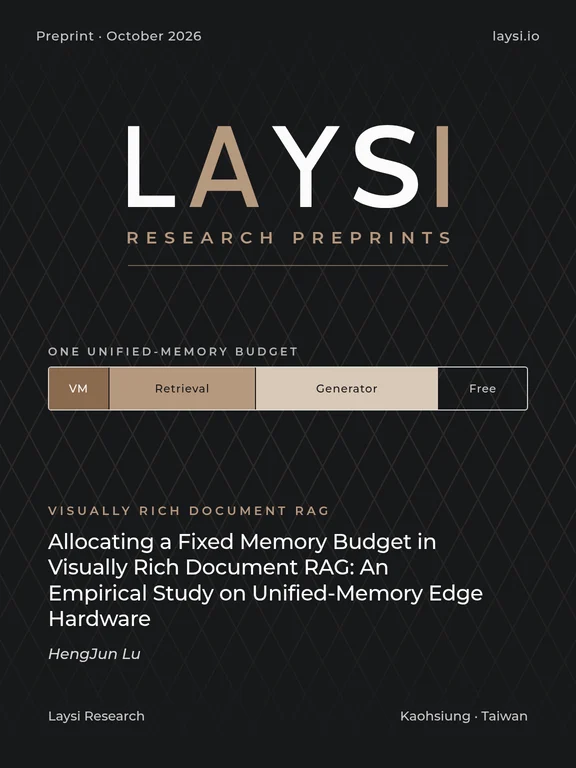
Allocating a Fixed Memory Budget in Visually Rich Document RAG: An Empirical Study on Unified-Memory Edge Hardware
Reading scans, slides and spreadsheets well takes several vision-language models at once. The work fits three of them and an application stack into the memory of one stock machine, and evaluates twelve ways of dividing that memory in speed, answer quality and stability.
Applied Research
Carry findings into operating tools
Products give the research a place to meet real responsibilities, data boundaries, and recurring decisions.

TrustIoT.AI
Research on zero-trust edge nodes becomes the hardware identity of every factory gateway, so each analysis and energy report TrustIoT.AI produces rests on verified data.

Laysi One
Research on zero-trust governance becomes the permission design of Laysi One: people and AI are authorised separately, nobody can promote themselves, and every call is on record.
Collaborate
Bring a hard question to the table
Technical collaborators, research peers, and people looking for demanding product work can start with a concrete question. The conversation can then find a useful point of contact between evidence and action.